
Ed Scott was running errands when a car pulled up to him while stopped at a traffic light.
The Memphis athletic director inched his car up and then noticed the car next to him did the same. He finally looked over and the man rolled down the window to tell him he was still riding high over the Tigers’ win over Arkansas. The man’s young son in the backseat let out a “Go Tigers Go.”
It crystallized what Scott quickly learned in his 14 months of running the Tigers’ athletics department: Memphis is a big city but it’s still a college city. Along with the Memphis Grizzlies, the second-largest city in Tennessee is rabid about its local college sports teams.
“We told folks we want to compete at the highest level and then when we got a chance to do it, we were able to host, put on a really good show and we won the game,” Scott told CBS Sports. “I think that just speaks volumes of Coach (Ryan) Silverfield and what he’s built, and where our department is right now, frankly.”
Meet Drew Mestemaker: North Texas QB enjoying breakout after never starting varsity game in high school
Shehan Jeyarajah

It is emblematic of where the American Conference is right now, too.
Memphis is 5-0 with a win over the Razorbacks. North Texas is 5-0 with a win over Washington State. South Florida (4-1) has two wins over then-ranked opponents in Boise State and Florida. Tulane has beaten two Power Four opponents (Duke and Northwestern) while Tulsa was the final nail in Mike Gundy’s coffin after the Golden Hurricane beat Oklahoma State. Navy is undefeated ahead of its game against Air Force (noon ET on CBS).
The American even has more wins over Power Four opponents (6) than the ACC (5). A year after watching Boise State grab the College Football Playoff automatic bid, the American is supremely well-positioned to be one of the five conferences to land a team in the playoff.
How did the American become the early toast of college football? It is a result of innovative leadership, increased institutional investment and a set of coaches that will be mentioned for every big job that opens up this coaching cycle.
A commissioner’s plan of action
A former Rutgers football player, Tim Pernetti has been on all sides of college athletics during his career. He got his start in television working at ABC Sports and CSTV — he worked with eventual Big Ten commissioner Tony Petitti at both — before becoming Rutgers’ AD and shepherding his alma mater into the Big Ten. He then worked for a MLS franchise and IMG Academy before succeeding Mike Aresco as the American’s commissioner.
Everywhere he’s been, Pernetti has brought an outside-the-box mentality to the job. Maintaining the status quo isn’t an option, especially at a conference like the American that has undergone considerable membership turnover over the last decade. Pernetti has been aggressive about positioning the American as an innovative conference willing to take some chances to stand out from the rest of college athletics. That has included a significant conference brand makeover that came with a name change, the first conference mascot (Soar the bald eagle) and a new slogan that feels especially apropos this season: “Built to Rise.”
Pernetti’s time on a college campus and experience with television rights gives him the credibility to get his constituents (namely college presidents and athletic directors) on board with big ideas. It’s one thing to have the idea, quite another to actually get it rubber-stamped by a typically risk-averse group.
“I’ve been really impressed at his ability to kind of put everything on the table and allow us a chance to be able to really look at it, to understand it, to explore it, to talk with our presidents, to have all of us know that we want to turn over every rock possible and to find a way to improve the individual schools,” said Tulane AD David Harris.
That includes establishing a minimum revenue share commitment level for each school. Pernetti saw what was coming with the impending House settlement that would allow universities to directly pay athletes for the first time and wanted to make sure his conference wasn’t left behind. It was a given that Big Ten and SEC schools would fully fund the $20.5 million annual number, but quite a different story elsewhere around college sports especially outside of the Power Four. Akin to going door-to-door, Pernetti met with university leaders at each of his 15 American schools and eventually got them on board with a minimum standard of $10 million in revenue share over three years. No other conference has established a minimum rev share number.
Most impressively so far, Pernetti has kept the band together. His predecessor, Aresco, was always having to fend off other conferences trying to poach the conference’s attractive programs. In just the last two years, the American lost SMU to the ACC and Cincinnati, UCF and Houston all to the Big 12. It wasn’t Aresco’s fault — the significant financial jump to a Power Four conference predictably wins out over loyalty — but a credit to how programs could develop within the conference.
There was risk again when the Pac-12 looked to expand its ranks last fall. The Pac-12 made a run at multiple American members, including Memphis and Tulane, but ultimately all decided to stay in the conference. Pernetti helped them understand that the money just didn’t make sense for them to leave and there was more value in staying in a conference on the rise. Rather than let rumors hang over the conference, he directly addressed the realignment rumors with the conference and wanted to lay out the facts before anyone made a decision. He came up with solutions like a new revenue distribution model that rewards football and basketball success.
It worked.
That doesn’t mean those threats have gone away. Memphis expressed interest in buying its way into the Big 12 in a unique pitch that would have seen the Tigers take no money for five years and an offer of more than $200 million, which included bringing sponsorship money to its new conference. The Big 12 ultimately wasn’t interested, but the allure of joining a Power Four conference will always be there for Group of Six schools.
Pernetti doesn’t take it personally.
“You can’t spend a lot of time playing defense,” Pernetti told CBS Sports. “You have to spend time creating new resources and generating new revenue and creating a higher level of competition in your league because you want to make it a place that people want to stay and that others want to come to. And, by the way, people are staying and we have a lot of encouraging conversations with people outside the conference. My job is to create more value however I can.”
That has included being open about meeting with private capital firms and considering their potential value for the conference. Pernetti also created American Rise Ventures, believing bringing brand partnerships and commercial enterprise in-house rather than farming it out to third parties would ultimately generate more revenue for the conference. It’s a bold bet but the kind of one the American needs to make in a new revenue share world that comes with an annual $20.5 million payment (if a school fully opts in) that’s particularly onerous at that level.
Certainly, it doesn’t hurt when American schools are beating Power Four opponents and generating national headlines, either. “When there’s tail winds like this, it helps everything,” Pernetti said.
Scott has seen the tailwinds in Memphis, too. He doesn’t hide his school’s ambitions and after beating Arkansas told CBS Sports: “If they’re not going to let us in, we want to play ’em.” The school is well-positioned in this new era to generate real NIL opportunities for its athletes, a major advantage if the College Sports Commission enforces its fair market value range for deals. FedEx and AutoZone are major corporate supporters of Tigers athletics. Scott says the athletic department raised more than $32 million last year — $26 million in cash.
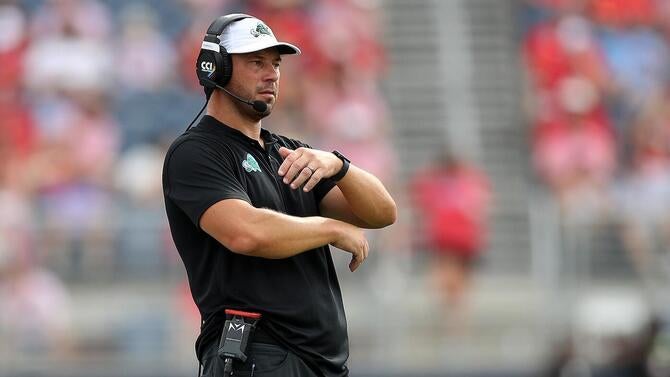
Just this season amidst a 5-0 start, Memphis coach Ryan Silverfield can see the difference. It’s not like his program hasn’t had tremendous success in the past — the Tigers went 11-2 a year ago and finished the season ranked in the top 25 — but the chance at a College Football Playoff berth has raised the stakes. Fans are more eager than ever to do what they can to add a little more coal to the Tigers’ speeding locomotive of a football program.
“You go the radio show and the restaurant is standing room only,” Silverfield said. “You’re able to make some pushes and some unique requests. People are saying, ‘Hey what do you need?’ Certainly, it bodes very well.”
If that support continues, including from the university level, Memphis could enter rarefied air for a non-Power Four school.
“I think we can actually get to a full rev share in the near future,” Scott said. “If we can do that, I think we can be competitive because we can acquire talent. And if we can acquire talent, then I think we’ve proven we have the facilities and the coaches who can win.”
Getty Images
The coaching carousel dilemma
There are already four Power Four job openings that have popped up this season — Arkansas, Oklahoma State, UCLA and Virginia Tech — plus Stanford hired Frank Reich on a one-year interim deal. For almost every opening now and still to come, it’s a good bet you’ll see three names mentioned for the jobs: Memphis’ Ryan Silverfield, South Florida’s Alex Golesh and Tulane’s Jon Sumrall.
They are all 45 or younger, they’ve all previously been at Power Four schools and they are all winning at a major clip.
Silverfield is 16-2 in his last 18 games which includes wins over Arkansas, Florida State and West Virginia.
Sumrall was already a top candidate for multiple jobs last cycle, including North Carolina and West Virginia, but opted to stay at Tulane when the school committed to an increased financial investment in the program. Tulane is a private school so salaries aren’t publicly available but industry sources believe Sumrall is one of, if not the, highest-paid coach at the Group of Six level.
There isn’t a day that goes by, though, that Harris doesn’t hear from fans about the need to keep Sumrall in New Orleans.
“What are you going to do to keep Jon Sumrall?” some tell him.
“You need to give him a blank check,” others say.
“You need to pile the money up so high in front of him there’s no chance he would ever want to leave.”
Harris understands the point and is committed to doing everything he can to keep Sumrall happy and keep the Tulane football momentum rolling. As one person close to Sumrall put it about other job possibilities, “If Tulane continues to invest in the program, you can afford to be patient.” A big part of that is continuing to be competitive in rev sharing to both retain current athletes and be able to add necessary ones in recruiting and out of the transfer portal.
Arkansas coaching candidates: Rhett Lashlee, Bobby Petrino among options on hot board to replace Sam Pittman
Will Backus
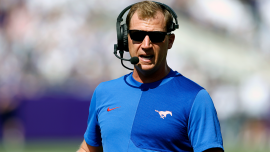
“Everyone wants to see that continue,” the Tulane AD said. “(The fans) understand that it requires an investment. They understand that requires having people in the right positions, especially in our leadership, with our head coach, and they want to do whatever they can to be able to help to sustain that.”
It’s no different in Memphis. Scott and Silverfield have a great relationship, and the Memphis AD has vowed to do everything in his power to keep the successful coach leading the Tigers. He knows Silverfield loves being in Memphis and wants to be there, but admits that there could come a time when a bigger program comes calling and gives him “an offer so good that he couldn’t refuse.”
For Silverfield, at least, there’s a world in which that never has to happen.
“I think if all three of us looked up and we were still in this conference in 10 years,” Silverfield said, “it means we had job stability, our schools did what they were supposed to and continued to invest.”