
Hamas leader Mousa Abu Marzouk’s recent legal challenge to have his organization removed from the UK’s terror list should serve as a wake-up call for American policymakers. This brazen attempt to legitimize Hamas comes from a member of the Muslim Brotherhood who arrived in the U.S. on a student visa in 1982 and spent 14 years helping plant the seeds for terror networks on American soil – networks that played a crucial role in the post-October 7 pro-Hamas demonstrations across our nation. There is a need to investigate this, and legislation recently introduced provides an opportunity to do so.
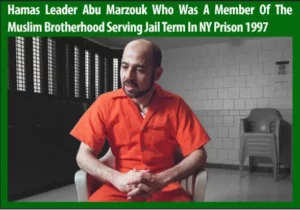
Abu Marzouk’s case exemplifies how terrorist organizations exploit America’s open society to establish deep roots here. During his U.S. stay, this multibillionaire now living in luxury in Qatar headed Hamas’s political wing while earning advanced degrees from Colorado State Universityand Louisiana’s Columbia State University. For over a decade, he operated freely, even seeking recognition from the Bush and Clinton administrations. The fact that he obtained a green card and raised millions of dollars for terrorism while living openly in America demonstrates how these organizations view our educational institutions not as pathways to integration, but as opportunities to embed operatives and build support networks.
The connection between Abu Marzouk and the infamous Holy Land Foundation (HLF) case exposes the true scope of one such network. The HLF – which had been under FBI surveillance since 1994 and, in December 2001, months after 9/11, was listed as a Specially Designated Terrorist and a Specially Designated Global Terrorist for funding Hamas and was shut down – was just the tip of the iceberg. Abu Marzouk was connected to a web of American Muslim organizations and figures that laundered millions of dollars for Hamas operations and global jihad with repercussions that are still felt today
Many individuals involved in these early networks have children and associates who now lead today’s pro-Hamas activism in the U.S. This appears to be the result of a calculated, long-term strategy rather than coincidence. Abu Marzouk’s own daughter and son still live in the Washington, D.C. suburbs.
Then consider also Dr. Tareq Al-Suwaidan, another influential figure from this network and a Muslim Brotherhood leader who established Islamic centers and mosques throughout the country in the late 1980s that remain active today. An open supporter of violent jihad and an unindicted HLF co-conspirator, he explained in a recent podcast that while studying in Oklahoma, he had established not only a mosque but “the Arab Muslim Association in all of America.” In another podcast, he discussed his participation in Islamist organizing in the U.S., in Florida where he was sent and later while attending Pennsylvania State University, where he established a mosque.
Al-Suwaidan is banned from entering the U.S. due to his terror ties and antisemitic statements – yet his daughter is a doctoral candidate and Prize Fellow in Philosophy of Religion at Harvard University and deeply involved in anti-Israel campus activities, and is known to have associatedwith anti-Israel members of Congress from “the Squad,” Reps. Rashida Tlaib and Alexandria Ocasio-Cortez.
The pattern continues with Sami Al-Arian, the former South Florida University professor who openly supports jihad and incites terrorism and who established Islamic fundraising organizations, including the Islamic Committee for Palestine and the World and Islam Studies Enterprise, Inc., while utilizing his university position as cover. Originally entering the U.S. on a student visa, living, inter alia, in Virginia, he was later convicted on terrorism charges and deported to Turkey. In a podcast last year Al-Arian said that the Muslim Brotherhood’s foundational work in the U.S. began in the early 1960s when Brotherhood members “came to the U.S. to study” and “settled in America.
“He should know. His children now hold influential positions in American academic and media circles – his daughter is a well-known U.S.-based journalist for Al-Jazeera English. Furthermore, his son-in-law was recently removed as department chair at Georgetown University after he publicly expressed hope that Iran would launch a “symbolic strike” on a U.S. base.
There is also Hatem Bazian, UC Berkeley professor, who is founder and chair of American Muslims for Palestine (AMP) – a successor organization of the Holy Land Foundation-linked Islamic Association for Palestine (IAP) and the American Muslim Society (AMS). He was a featured speaker at a 2004 fundraiser for KindHearts, an organization described by the U.S. Department of the Treasury as “the progeny of Holy Land Foundation,” alongside another featured speaker, Mohammed Al-Mezain, one of the Holy Land Five who served 15 years in prisonfor his role in the HLF case and was released in 2022 and deported to Turkey. Bazian is the leader of the BDS movement and anti-Israel activism on campuses and encampments across the U.S. and Canada since October 7.
Sabri Samirah, a Jordanian Muslim Brotherhood leader living illegally in Chicago, served as chairman and board of directors member of the Islamic Association of Palestine (IAP) which is an unindicted co-conspirator in the Holy Land Foundation trial; during the trial, the federal government had successfully argued that IAP’s purpose was to support Hamas with “propaganda and information.” Samirah was barred from returning to the U.S. after a visit to Jordan in 2003 for national security reasons but eventually won a lawsuit to be allowed to return under President Obama in 2010. His son, a former delegate in the Virginia legislature and a former campaign official for Rep. Rashida Tlaib, is connected to antisemitic and anti-Israel organizations. He was an active member of the AMP-linked Students for Justice in Palestine.
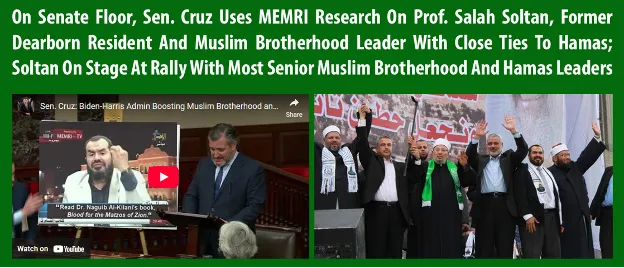
Another example of a Muslim Brotherhood leader coming to the U.S. and establishing Islamist institutions is the Egypt-born Prof. Salah Soltan. He lived and worked in the U.S. for over a decade, residing in Dearborn, Michigan and establishing the Islamic American University in Southfield, Michigan, which he headed from 1999 to 2004 and was actively at least up to 2024. Before coming to the U.S., he had been a professor of Islamic Law at Cairo University. He was arrested in Egypt in September 2013 for opposing the removal of that country’s Muslim Brotherhood president Mohamed Morsi, and in 2015 was convicted for his leadership role in the Muslim Brotherhood and sentenced to death. In 2021, Sen. Ted Cruz (R-TX) used MEMRI research on Soltan on the Senate floor, commenting that the Biden-Harris administration was “once again boosting the Muslim Brotherhood.”
The Muslim Brotherhood’s own strategic document, entered as evidence in federal court during the HLF trial, outlined its “grand jihad” in America for “eliminating and destroying the Western civilization from within.” This was not hyperbole – it was the organization’s explicit blueprint, requiring activists to implement its agenda.
Five HLF leaders are still imprisoned in the U.S.; another, the brother of Hamas leader abroad Khaled Mashal, was released late last year from federal prison in Texas. Islamist groups and designated terrorist organizations with a U.S. presence including those under investigation continue to call for their release including Council on American-Islamic Relations (CAIR), Students for Justice in Palestine (SJP), Within Our Lifetime, and Samidoun. The most extensive archives on the HLF case can be found on the website of Steven Emerson’s Investigative Project on Terrorism; his groundbreaking research was the first to expose the threat of jihad in America.
Today’s Islamist organizations that are under investigation – including the Council for American-Islamic Relations (CAIR) about which Sen. Tom Cotton recently wrote a Congressional letter requesting an investigation for its terrorist ties, including to the Muslim Brotherhood and Hamas; American Muslims for Palestine (AMP); and the Islamic Society Of North America (ISNA) – have documented roots in or were themselves unindicted co-conspirators in the HLF case.
In a sign of things to come, in an August 13 interview about a U.S. designation of the Muslim Brotherhood and the Council on American-Islamic Relations (CAIR) as terrorist, Secretary of State Marco Rubio said that this was “in process.” He added: “We are constantly reviewing for groups to designate for what they are: supporters of terrorists, maybe terrorists themselves… You’ve mentioned a couple of names, particularly the Muslim Brotherhood, that are of grave concern.”
These organizations’ transformation from underground networks into mainstream advocacy groups reflects the Muslim Brotherhood’s long-term strategy. The coordinated nature of the post-October 7 protests across the West provides additional cause for concern – their identical messaging and tactics suggest pre-planning rather than spontaneous reactions to events in Gaza.
There is growing bipartisan support for action. Democrats like Rep. Jared Moskowitz and Republicans like Reps. Nancy Mace and Rany Fine have written Congressional letters and introduced legislation to designate the Muslim Brotherhood as a terrorist organization. Sen. Ted Cruz and half a dozen cosponsors recently introduced similar legislation. He stated that the Muslim Brotherhood “provides support” to its other branches “that are terrorist
organizations,” including Hamas, that it is “committed to the overthrow and destruction of America” and that it poses “an acute threat to American national security interests.” The U.S., he said, should “expeditiously” designate it terrorist, as U.S. allies in Europe and the Middle East.
But designation alone is not sufficient. Congress must examine the full scope of Muslim Brotherhood operations in the U.S. over the past two decades. We need comprehensive answers: What other networks exist? What are their current activities and their goals for the future? How did organizations with documented ties to terrorism financing continue to operate and influence American policy and send students here? We must investigate the extent to which foreign terrorist organizations have infiltrated our institutions, especially on university campuses, in the media, and on Capitol Hill.
Abu Marzouk’s legal maneuver to remove Hamas’s terror designation and the long-term plans of his allies reminds us that terrorist organizations never abandon their ultimate goals – they simply adopt new tactics and bide their time.
To view the original article as well as additional reports from the Middle East Media Research Institute, visit MEMRI’s website.