
For centuries monasteries have preserved the island of Crete’s interwoven Christian
tradition and complex cultural identity, capturing the interest of present-day church
historians. This summer Dyron B. Daughrity, divisional dean of religion and philosophy and William S. Banowsky Chair in Religion,
embarked on a research trip to Crete, visiting 22 Cretan monasteries—many still in
operation—to study how their historical significance and ongoing theological traditions
could positively influence contemporary faith-based institutions.
“The Christian university, with its roots in the monastery, has values that are notably
reflected in Crete’s monastic tradition,” says Daughrity. “Monasteries hold Crete’s
long and storied past that stand as global symbols of freedom, faith, and resilience.”
Interior of the Cathedral of Saint Titus
Daughrity’s trip began in Heraklion, Crete’s capital and the site of the Cathedral
of Saint Titus, which embodies the heart of Crete’s Christian tradition. Around AD
61-64 the Apostle Paul introduced Christianity to Crete, leaving behind his companion,
Titus, whom Paul ordained as the first bishop of Crete. Paul needed Titus to organize
the church there, and to address false teachings. The Heraklion cathedral was established
in the 10th century under rule of the Byzantine empire and is dedicated to Titus,
Crete’s patron saint.
“It is amazing to realize that the New Testament geography is still there for us to
see,” says Daughrity. “It increases confidence in the glorious text that anchors our
faith.”
Daughrity continued his travels to significant Cretan cities such as Agios Nikolaos,
Rethymno, and Chania, visiting monasteries and interacting with monks and nuns in
their daily work. Located near Chania, the Gouverneto Monastery, known as one of Crete’s
oldest, was established in the 16th century when the Republic of Venice assumed control
over Crete after the Fourth Crusade. The monastery is known for its distinct qualities
of Venetian architecture and remains active today, housing 11 monks.
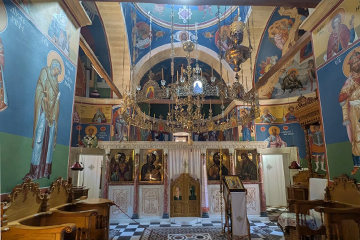 Interior of the Gouverneto Monastery
“Here I visited with a monk who also serves as a medical doctor in a nearby clinic,”
says Daughrity. “He is 32 years old, and has lived in the monastery for eight years.
Amid busy monastery work, he takes care of a fellow monk that has ALS and another
that has lung cancer. His acts of service, which embody Christ’s teachings, reflect
a lifestyle lost to modern society. All the monks seem to really care about is Jesus
Christ, the church, and their brotherly fellowship—and we need that. We need people
among us whose whole life is God and His kingdom.”
Another notable Cretan monastery on Daughrity’s itinerary was the Monastery of Christ
the Savior, located along the coast in Rethymno. In 1646 the monastery was completely
destroyed when the Ottoman Empire overtook Crete, and it wasn’t rebuilt until 1935
when Nestoras Vassalos, a monk and well-known icon painter, had settled there after
a vision that he had while at Mount Athos. Since then, the monastery has been functioning
as a nunnery dedicated to bookbinding, literary pursuits, and the art of Byzantine
iconography. Upon his visit, Daughrity was assigned an English-speaking nun to acquaint
him with the convent’s operations.
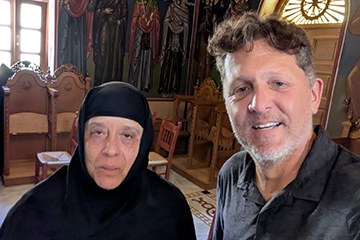 Daughrity with his newfound friend at Monastery of Christ the Savior
“After visiting the chapel, the nun hosting me asked me for a ride to her ailing father’s
house in Rethymno,” says Daughrity. “But we had to rush, as she feared the strict
abbess might see her getting a ride with a man! As I only know Koine and modern Greek
letters, she took the time to help me understand Byzantine Greek letters, and told
me that she has been a nun since the age of 20. That’s 32 years! We were both excited
to realize that we are the exact same age—52.”
Daughrity will purpose this monasticism research toward future book publications and
articles. He plans to argue that Christian institutions—particularly Protestant ones—need
to be aware of the monastic cultures within Christianity. Protestants operate without
the internal scaffolding found in Catholic and Orthodox traditions, but they will
benefit by understanding the church’s monastic heritage. Daughrity explains, “Understanding
monastic forms of Christian faith will enhance our understanding of church history,
and will enable us to preserve and strengthen our own Christian communities.”
In addition to his faculty position at Seaver College, Daughrity has authored and
edited more than 20 books on the topics of global Christianity and church history,
leads as general editor for several publications including the Bloomsbury Religion in North America project and the acclaimed series Christians in the City with Bloomsbury Academic. He also serves as senior minister for Hilltop Community
Church in El Segundo.
“Receiving hospitality from the monks and nuns at Cretan monasteries while witnessing
their acts of service was a special opportunity,” says Daughrity. “Through the continuation
of actively studying, preserving, and interacting with church history we understand
what it means to be a Christian university.”